
Mid-Transformation Challenges: Leveraging Ambidextrous Leadership for Sustainable Change

Bildquelle: Pexels
Companies must constantly adapt to remain competitive. However, many are facing unexpected challenges during transformations initiated in recent years. Especially in the middle of transformative processes, initial enthusiasm might wane, while the benefits are not yet fully realized, and skepticism arises. This article examines the challenges that arise during mid-transformation processes and how Ambidextrous Leadership can help foster sustainable change.
The (re-)insurance industry is undergoing significant transformation driven by technological innovations, shifting customer needs, increasing regulatory requirements, and climate change. Companies must constantly adapt to remain competitive. However, many are facing unexpected challenges during transformations initiated in recent years. Especially in the middle of transformative processes, initial enthusiasm might wane, while the benefits are not yet fully realized, and skepticism arises. In this challenging phase, a critical factor is how leaders support their organizations adapting to the changes. Ambidextrous Leadership, or the ability to manage both exploratory and exploitative activities, can be a key tool in balancing the maintenance of proven practices with the exploration of new paths for innovation. This article examines the challenges that arise during mid-transformation processes and how Ambidextrous Leadership can help foster sustainable change.
The Need for Transformation in the (Re-)Insurance Industry
The (re-)insurance industry is pressured to modernize its business models and adapt to new market demands. Factors such as digitalization, new technologies (e.g. artificial intelligence, big data, IoT), the need for enhanced customer interaction and experience, increasing regulatory requirements, and climate change are forcing (re-)insurance companies to rethink their traditional business models. These changes require not only technological adjustments but also profound cultural and organizational transformations.
Mid-Transformation Challenges
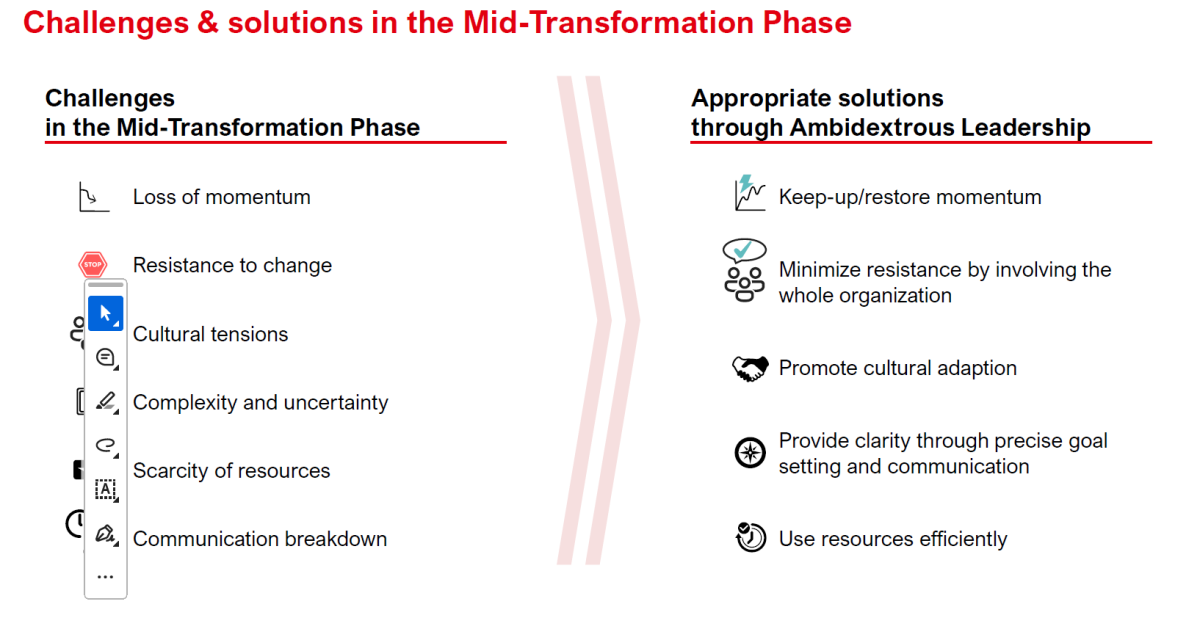
Many companies in the (re-)insurance industry are currently in the midst of their transformation journey. This mid-transformation phase is often the most challenging phase, as initial successes are delayed, and employee enthusiasm wanes. Typical challenges during this midtransformation
phase include:
- Loss of Momentum: Transformational initiatives often begin with strong momentum and a clear focus. Over time, however, the initial energy and commitment may wane, especially if short-term successes are lacking.
- Resistance to Change: Even with a strong start, resistance to change can increase as the impacts of increasing workload, transformation on daily work and existing processes become more apparent.
- Communication Breakdowns: Inadequate project communication can lead to misunderstandings, misalignment, or even rumors within the organization.
- Cultural Tensions: Transformations often require deep cultural changes that can challenge established norms and values, leading to internal tensions and divisions within the workforce.
- Complexity and Uncertainty: The complexity of large-scale transformation initiatives can lead to uncertainties about the future course and ultimate goals. The workforce may lose confidence if the direction of the transformation is unclear, constantly changing, or potential negative personal implications are not addressed.
- Resource Scarcity: During transformation, there may be a reallocation of resources, leading to bottlenecks in other areas of the company. Particularly balancing day-to-day operations with transformation efforts can place additional pressure on both the workforce and management.
Ambidextrous Leadership as a Solution
Ambidextrous Leadership, the ability to support both exploratory and exploitative activities simultaneously, offers a promising approach to overcoming some of the mid-transformation challenges. This leadership style requires balancing the promotion of innovation with the maintenance of operational excellence.
Definition and Principles of Ambidextrous Leadership:
- Encouraging Exploration: Exploratory leadership aims to support innovative approaches, tolerate uncertainty, and foster experimentation. This is crucial during transformation phases when new ideas and approaches need to be tested. (1)
- Ensuring Exploitation: At the same time, it is necessary to practice exploitative leadership, focusing on efficiency, optimization, and the refinement of existing processes. This balance prevents companies from losing their existing capabilities during transformation. (1)
- Contextual Ambidexterity: This form of ambidexterity emphasizes the ability of leaders to switch between exploratory and exploitative leadership styles depending on the situation and context. (2)
Implementing Ambidextrous Leadership in Mid-Transformation Processes
Implementing Ambidextrous Leadership in transformation processes is no easy task. It requires both structural adjustments and a cultural shift. Here are some steps companies can take:
- Be open to Creating Dual Structures: To support both exploratory and exploitative activities, companies should consider developing dual structures. This means creating separate teams or departments, each focusing on innovation (exploration) and efficiency (exploitation).
- Clear Communication of Vision and Goals: Leaders must communicate clearly and continuously why transformation is necessary and how exploratory and exploitative approaches contribute to achieving overall goals. Innovating and tackling something „new” is often perceived as special, it is fundamental to showcase that only successful exploitation can provide the financial means to explore new ways forward. Only tackling and promoting both sides will put organizations in a position to really harvest the full potential.
- Promote an Adaptive Leadership Culture: It is important to create a culture that promotes adaptability and flexibility. This might involve shifting from a rather directive approach to a more empowering one as circumstances change. To promote this, companies should next to trainings or coaching, also focus on creating an environment where it is safe to make mistakes and learn from them.
- Identify Measurable Progress and Quick Wins: Short-term successes (quick wins) help maintain employee engagement and build confidence in the transformation process. These successes should result from both exploratory and exploitative actions.
Regular Review and Adjustment of Strategy: Transformation should be viewed as an iterative process requiring regular reviews and adjustments. Leaders must remain agile enough to respond to new challenges and opportunities. - Continuous Learning and Adaptation: Leaders must be committed to continuous learning and adaptation. It is crucial to stay abreast of new trends, while also investing in know-how to refine existing processes.
Challenges in Implementing Ambidextrous Leadership
While Ambidextrous Leadership is promising, there are also challenges in its implementation. These include:
- Resource Conflicts: Supporting both exploratory and exploitative activities simultaneously can lead to internal resource conflicts.
- Cultural Barriers: Creating a culture that supports both stability and change is a challenging task and requires a profound rethinking in many companies.
- Leadership Development: Ambidextrous Leadership requires a new type of leadership development, where leaders must be capable of optimizing existing processes while fostering new ideas and taking risks.
The Role of Leaders in the Mid-Transformation Phase
In the mid-transformation phase, leaders are required to play a critical role. Their role goes beyond traditional management; they must act as visionaries, facilitators, and coaches to navigate the complex dynamics that arise during this phase. To fulfill this role effectively, they must maintain strategic clarity while addressing the emotional and psychological needs of their teams. This requires a combination of hard and soft leadership skills.
- Strategic Clarity and Communication: During mid-transformation, it is easy for the original vision and associated goals to be lost. Leaders must ensure that the strategic objectives are always clearly communicated. Regular updates, open forums for questions and feedback, and a continuous emphasis on long-term goals help keep all employees on track. At the same time, leaders must break down high-level strategic goals to ensure employees understand how these goals impact them personally.
- Emotional Intelligence and Empathy: Leaders should recognize and respond to the emotional states of their teams. During the mid-transformation phase, it is normal for employees to feel uncertainty, fear, or even resignation. Empathy and emotional intelligence are crucial to acknowledging and addressing these feelings. Leaders must create spaces where employees can express their serious concerns without being deemed as unsupportive critics. Fostering a positive and supportive work environment is key.
- Flexibility and Adaptability: A successful leader during transformation must be able to respond flexibly and adjust strategies as needed. This may mean making short-term course corrections or setting new priorities without losing sight of the long-term vision.

Case Study: Ambidextrous Leadership in Practice
To better illustrate the application of Ambidextrous Leadership, consider the example of a large insurance company during a digital transformation process.
- Company Background: The insurance company faced stagnant growth rates, outdated IT infrastructure, and a growing gap between customer expectations and the services offered. The management decided to pursue a comprehensive digital transformation.
- Transformation Approach: The company implemented a dual structure, where one part of the business focused on optimizing existing processes and services (exploitation), while another part pursued exploratory projects such as developing digital marketing channels and experimenting with innovative technologies (exploration). This meant to actively investing in both areas. The exploitation side had the opportunity to secure tactical improvements, while exploration focused on strategic change.
- Results and Insights: By applying Ambidextrous Leadership principles, the company achieved both short-term efficiency gains and explored new market segments. The clear separation and simultaneous integration of both approaches allowed the company to respond flexibly to market changes and foster a culture of continuous improvement.
Building an Ambidextrous Culture: Practical Steps
To successfully implement Ambidextrous Leadership, it is not enough to train leaders alone. The entire organiza-tion must embrace a culture of ambidexterity. Here are some practical steps companies can take to build such a culture:
- Promote a Learning Culture: An organization that successfully implements both exploratory and exploitative ac-tivities must have a strong learning culture. This means viewing learning as a continuous process and seeing mistakes as opportunities for improvement. Companies can support this through regular training, workshops, and learning programs.
- Create Psychological Safety: Employees must feel safe taking risks and proposing new ideas without fear of reprisals or negative criticism. This requires an environment open to discussions where mistakes are seen as part of the innovation process.
- Develop a Leadership Culture: Delegate responsibility and encourage employees to take initiative. Change flourishes when leaders emerge from all levels of the company, working alongside the management team to motivate the organization towards achieving its goals. Leaders don’t have to be managers, and especially in uncertain or ambidextrous times, organizations benefit from widely distributed momentum.
- Reward Both Innovation and Efficiency: Companies should develop a reward system that recognizes both exploratory and exploitative performance. This could be achieved through dual career paths or hybrid assessment frameworks that consider both contributions to innovation and operational excellence.
- Promote Cross-Functional Teams: Cross-functional teams, including members focusing on efficiency and innovation, can help integrate the best of both worlds. These teams foster mutual learning and collaboration between different functional areas.
- Invest in Technology and Infrastructure: Supporting ambidextrous activities also requires the right technological infrastructure. Investments in modern tools and technologies that support both exploring new business opportunities and optimizing existing processes are essential.
Conclusion and Outlook: Ambidextrous Leadership as a Key to Successful Transformations
Companies face significant challenges in their transformation processes. Ambidextrous Leadership offers a promising method to overcome these and promote sustainable change. By balancing exploration and exploitation, companies can ensure that they leverage their current strengths while seizing future opportunities. However, successful implementation requires careful planning, clear communication, and a culture of adaptability. Only in this way can a sustainable transformation succeed in making companies fit for the future.
The path to successful transformation is complex and challenging, but with Ambidextrous Leadership, companies have a powerful tool to achieve their goals and remain competitive in an ever-changing world. Mid-transformation can be a difficult time for any company, especially in the complex and rapidly changing (re-)insurance industry. Ambidextrous Leadership offers a clear path to overcoming these challenges by balancing efficiency and innovation.
Successfully implementing it requires strong leadership that is both strategic and emotionally intelligent. It also necessitates a culture that is open to change and promotes both learning, adaptation and taking initiative. When these elements come together, (re-)insurance companies can not only successfully navigate the mid-transformation challenges but also lay a sustainable foundation for future growth and success.
The (re-)insurance industry is at a demanding stage in its development. We believe that companies that adopt and implement the principles of Ambidextrous Leadership will be better positioned to meet future challenges and strengthen their position in the market. It is time to see transformation not just as a necessity but as an opportunity – a chance to renew, grow, while not forgetting what made one successful in the past.
(1) The Ambidextrous Organization, Harvard Business Review, 2004.
(2) Organisational ambidexterity, think at London Business School, 2014.
Autoren: Sven Trautner, Chief Strategy Officer & Head of Corporate Development at VIG Re; Dr. Marco Englert, Geschäftsführer Molentum
Der Beitrag stammt aus dem Sammelband „Insurance & Innovation“, 2025, VVW GmbH. ISBN-10: 3963295325


